
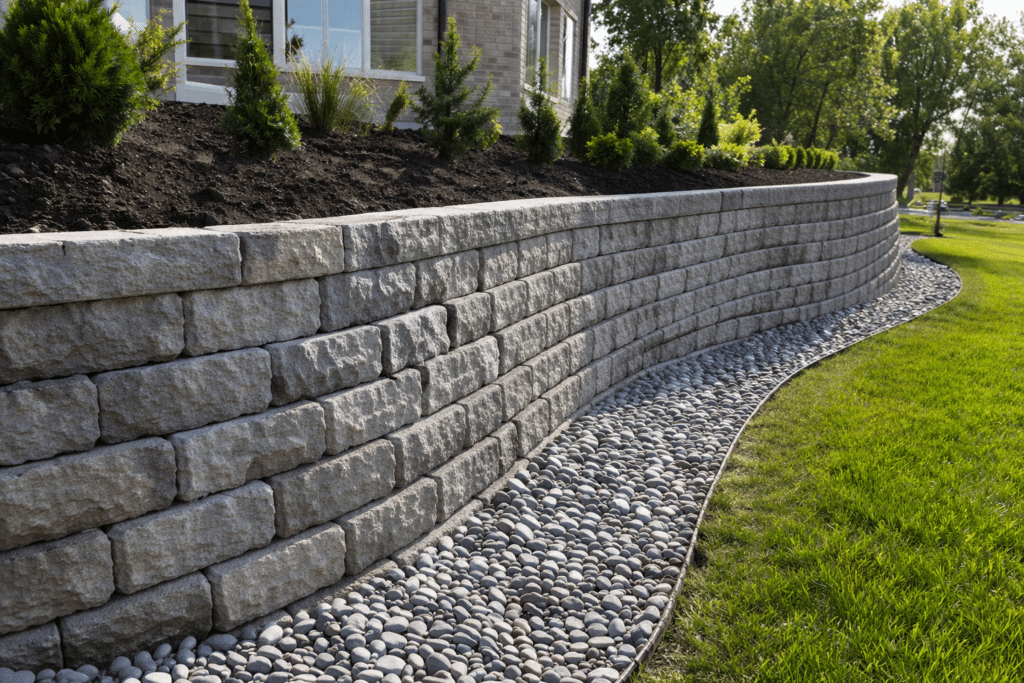
If you are searching for retaining wall installation in Northern Illinois, you are usually dealing with a sloped yard you want to use, or a wall that is starting to fail. Either way, the goal is the same. You want a wall that looks great, holds back soil safely, and does not start leaning a few seasons later.
In Illinois, retaining walls take a beating from wet springs, saturated clay soil, and repeated freeze-thaw cycles. That is why the “pretty” part of a wall (the face) is only half the story. The long-term success comes down to base prep, backfill choices, and especially drainage.
This guide breaks down what retaining walls actually do, the most common failure causes, how to choose the right wall type for your property, and when a repair makes sense versus a full retaining wall replacement. Along the way, you will also see what to ask if you are searching for retaining wall contractors or “retaining wall repair near me” and want to hire confidently.
Table of Contents
What does a retaining wall do and when do you actually need one?
A retaining wall is a structure built to hold back soil so you can change grades safely. In real-life yards, that usually means creating flat space where there used to be a slope, protecting soil from washing out, or supporting hardscape features like patios, walkways, and steps.
What retaining walls are great for:
- Turning a sloped backyard into a usable lawn, play area, or seating space
- Building terraces that reduce long downhill runoff (a common erosion trigger)
- Supporting a patio edge so pavers stay stable over time
- Creating garden beds that do not spill downhill after storms
- Solving problem areas where soil keeps sliding or washing out
Quick “do you need one?” checklist:
- Your yard has a slope that limits where you can place a patio, fire pit, or outdoor seating
- You see exposed roots or bare soil after heavy rain (early erosion control landscaping warning)
- Mulch and soil repeatedly migrate downhill
- A previous wall is leaning, bulging, or shedding stones/blocks
- Water flows down the slope fast enough to carve channels
If you are planning a broader outdoor upgrade, it helps to think of a wall as part of the larger hardscape system. A retaining wall can be the difference between a patio that stays level and one that slowly shifts. For a bigger-picture overview, reference The Ultimate Guide to Hardscaping.
What are the most common reasons retaining walls fail or start leaning?
Most retaining wall problems are not caused by “bad blocks” or “bad stone.” They are caused by physics. Soil gets heavy when it is wet, water pushes outward, and freeze-thaw cycles amplify movement. When a wall is not built to manage those forces, it starts to rotate, bulge, or separate.
The most common failure drivers:
- Poor drainage behind the wall, which allows water pressure to build [1]
- A weak or poorly compacted base that settles unevenly
- Wrong backfill material (native soil instead of free-draining aggregate)
- No reinforcement where reinforcement is needed (height and slope matter)
- Surface water aimed at the wall (roof runoff, downspouts, or uphill grading)
- Hidden surcharge loads (driveways, sheds, fences, or steep backslopes) [5]
A simple way to think about it is this:
“When water cannot escape, the wall is being asked to hold back soil and water at the same time.”
Symptom-to-cause table (fast diagnosis):
| What you see | Likely cause | Why it matters |
|---|---|---|
| Wall leans forward over time | Drainage and/or base issues | Water and settlement increase outward force [1] |
| Bulging in the middle | Localized pressure + poor backfill | The wall face is deforming under load |
| Cracks, gaps, or separating caps | Movement from settlement or frost | Freeze-thaw can magnify small shifts |
| Washout at the base | Poor grading or discharge | Erosion undermines the wall footing |
| Damp soil staying wet behind wall | Drainage is not working | Saturated soil is heavier and pushes harder |
Mini-summary: If a wall is moving, do not assume the fix is cosmetic. Movement is usually a drainage, base, or load problem first.
What retaining wall types work best for Northern Illinois / Illinois (block, stone, boulder, timber)?
Northern Illinois properties often combine heavy soil, periodic saturation, and temperature swings. That makes material choice important, but the bigger decision is matching the wall system to the site conditions (height, slope, loads, and water).
Common residential retaining wall types:
| Wall type | Best use cases | Strengths | Watch-outs |
|---|---|---|---|
| Segmental retaining wall (stacked concrete block system) | Straight or curved walls, terraces, clean finished look | Modular, consistent, easy to repair in sections | Needs correct base, backfill, and drainage to last |
| Natural stone wall | High-end landscapes, classic look, varied textures | Unique appearance, strong when properly built | Skilled installation matters; stone selection and fit are critical |
| Boulder wall (rockery style) | Rustic style, larger footprints, some slope stabilization | Natural look, can handle minor movement visually | Requires equipment and space; drainage still matters [5] |
| Timber wall | Short walls, budget-driven projects | Quick install for low heights | Shorter lifespan; more vulnerable to moisture and decay |
How to choose the right type without overthinking it:
- Height and soil pressure: Taller walls and steeper slopes need systems designed for those forces.
- Aesthetics: Block vs stone is often a style decision once performance needs are met.
- Space: Some wall styles need more “footprint” behind the wall for stability.
- Integration: If the wall ties into a patio, stairs, or walkway, pick materials that blend well. For paver tie-ins, see The Ultimate Guide to Paver Brick Installation.
If you are comparing block retaining wall vs natural stone, the best answer is usually: choose the look you want after the design has confirmed the wall system matches the site loads and drainage needs.

Why is retaining wall drainage so important and how is it installed correctly?
Drainage is the #1 factor that determines whether a retaining wall stays stable or starts to lean over time. When water collects behind a wall, it increases lateral pressure and can drive movement. Good designs treat water management as a primary consideration, not an afterthought [2].
What “proper retaining wall drainage” usually includes:
- A free-draining gravel zone behind the wall face to move water downward [1]
- A drain pipe positioned to collect and carry water to a discharge point [1]
- Filter fabric placed to help keep soil fines from clogging the drainage stone [1]
- Grading at the top to keep surface runoff from dumping behind the wall [1]
- A planned discharge route so collected water can safely exit [2]
Compact text chart: typical drainage stack (wall face moving back into the yard):
- Wall face
- Drainage gravel zone
- Filter fabric boundary
- Reinforced/backfill zone as designed
- Native soil beyond the design zone
- Drain pipe collecting water and routing to discharge [1]
Common drainage mistakes that cause expensive callbacks:
- Using native soil as backfill directly behind the wall (it holds water)
- Installing a drain pipe without a clear discharge plan (water has nowhere to go) [2]
- Letting downspouts dump into the backfill zone
- Creating a “bowl” at the top of the wall that funnels runoff behind it
Where a rain garden can help: If your yard sends a lot of runoff toward the wall area, capturing water uphill can reduce stress on the wall. Rain Garden Landscaping can be a smart complementary strategy, especially when you want better drainage and better curb appeal in the same project.
Mini-summary: A wall does not fail because it got wet once. It fails because water keeps getting trapped behind it season after season. Drainage is how you stop that cycle. [1] [2]
How do you know if you need retaining wall repair or full replacement?
Retaining wall repair is possible when the wall is structurally sound and the problem is limited (loose caps, a small settled area, surface drainage tweaks). Replacement is more likely when the wall is actively rotating, bulging, or built on a base that has failed.
Repair vs replacement decision table:
| Condition | Repair is often reasonable when… | Replacement is often smarter when… |
|---|---|---|
| Leaning | Lean is minor and stable, with a clear drainage fix | Wall continues to move, bulge, or rotate forward |
| Bulging | Bulge is localized and the structure is otherwise sound | Bulge indicates broad pressure and structural distortion |
| Drainage | Drainage can be added or improved without major rebuild | There is no room to correct drainage without rebuilding |
| Base | Base appears intact and level in most areas | Base settlement is widespread or the wall steps are incorrect |
| Age/material | Materials are in good shape and can be reset | Materials are deteriorated or not designed for the loads |
Fast homeowner checks (non-invasive):
- Stand back and sight along the wall face. Any bowing or forward lean is a warning.
- Look for gaps that are widening between blocks, stones, or caps.
- Watch after a heavy rain. If the area stays saturated, the drainage plan is failing.
- Check for soil washout at the base or at the ends. That can signal water routing issues.
If you are searching “retaining wall replacement” because the wall is leaning and getting worse, it is worth scheduling an evaluation before the movement becomes a full failure.
What affects retaining wall installation cost (without giving exact prices)?
Retaining wall installation cost depends most on site conditions, especially height, access, and drainage routing, not just the face material. Two walls with the same length can have very different scope depending on excavation depth, drainage routing, and whether reinforcement is required.
Biggest cost factors (what changes the scope):
- Wall height and retained soil volume: Taller walls require more excavation, base material, and structural planning.
- Wall length and layout: Curves, corners, and terraces increase labor and detailing.
- Drainage complexity: Routing water to a safe discharge point can add significant work. [2]
- Reinforcement needs: Some sites require engineered reinforcement approaches based on loads and soil conditions. [2]
- Access: Tight gates, steep yards, or limited equipment access can raise labor time.
- Demo and disposal: Removing an old wall and hauling material is real cost.
- Finish details: Caps, steps, lighting integration, and landscape restoration add value and time.
- Tie-ins to other projects: Connecting to patios, stairs, or walkways often improves the end result, but adds scope.
Cost-factor table (plain-English version):
| Factor | Usually increases cost because… |
|---|---|
| Poor soil / wet conditions | More base work and water management needed |
| No easy discharge point | Drainage must be engineered to exit safely [2] |
| Tiered walls | More layout, excavation, and detailing |
| Curves and corners | More cutting and fitting time |
| Rebuild vs new | Demolition, disposal, and regrading are added steps |
If you want an accurate number, the fastest path is an on-site visit that confirms height, grade changes, drainage routing, and access. That is also how you avoid surprise change orders.

What retaining wall mistakes should homeowners avoid?
Retaining walls look straightforward, so the most expensive mistakes often happen before the first block or stone is placed. The wall can look “fine” on day one and still be destined to move.
Most common mistakes (and what they cause):
- Skipping the drainage plan or installing drainage without a discharge route [2]
- Building on soil instead of a properly prepared, compacted base
- Backfilling with heavy native soil directly behind the wall face
- Letting surface water or downspouts dump behind the wall
- Not accounting for hidden loads (driveway edges, slopes above, fences, or structures) [5]
- Trying to “straighten” a failing wall without fixing the pressure behind it
- Ignoring permit or plan requirements that may apply based on height and location [3] [4]
Mini-summary: A wall is not just a stack of materials. It is a system. When one part is skipped (usually drainage), the system eventually shows it. [1] [2]
How long does a retaining wall installation usually take and what’s the process?
Most residential retaining wall projects follow a predictable sequence, but timeline depends on wall size, access, weather, and whether the job includes demolition, grading, or tie-ins to patios and steps.
Typical process (what to expect):
- Site evaluation and measurements
- Design decisions (type, height, layout, drainage routing)
- Excavation and removal of unsuitable material
- Base installation and compaction
- Setting the first course accurately (this controls the whole wall)
- Drainage components and backfill staged as the wall rises [1]
- Reinforcement as required by the design approach [2]
- Caps, finishing, grading, and cleanup
- Landscape restoration (seed, sod, mulch, plantings)
Timeline reality check:
- Small, straightforward walls with good access can move quickly once materials are staged.
- Larger walls, tiered designs, or rebuilds often take longer because excavation, base work, and cleanup are a bigger share of the scope.
- Weather matters in Illinois. Wet soil slows compaction and increases the need for good staging decisions.
If your project includes a patio or outdoor living upgrade, coordinating the wall and the hardscape as one plan usually produces a cleaner finished look. The Ultimate Guide to Hardscaping is a helpful companion read when you are planning the full layout.
How do you maintain a retaining wall so it lasts longer?
A properly built wall should not require constant attention, but small maintenance habits make a big difference over time, especially in Northern Illinois.
Seasonal maintenance text chart:
- Early spring: Walk the wall line, check for new movement, and confirm water is not pooling behind the top edge.
- After heavy rain: Look for washout at the base and at wall ends. Fix grading early.
- Fall: Clear leaves and debris that block drainage outlets or surface flow paths.
- Anytime: Keep downspout discharge away from the wall and avoid creating a funnel at the top.
Practical maintenance tips:
- Surface water control: Re-grade small low spots at the top so water does not collect behind the wall.
- Outlet awareness: If your wall has drainage outlets, keep them clear.
- Plant choices: Avoid aggressive roots right at the wall face unless the design planned for them.
- Avoid added loads: Be cautious about adding heavy features near the top edge without evaluating loads. [5]
If you want drainage improvements that also look intentional, Rain Garden Landscaping can be a smart addition in areas where runoff consistently concentrates.
When should you call retaining wall contractors in Northern Illinois / Illinois?
If the wall is moving, if water issues are involved, or if the project changes grades near your home, calling retaining wall contractors early usually saves money and stress. A good evaluation focuses on why the wall is stressed and how to remove that stress long term, especially through water management. [2]
Call a pro if any of these are true:
- The wall is leaning, bowing, or bulging (leaning retaining wall repair is rarely just a surface fix)
- You see repeated wet soil or pooling behind the wall area
- The wall supports a driveway edge, structure, or steep slope (hidden load risk) [5]
- You want tiered walls on a steep yard (backyard slope solutions often need a coordinated plan)
- You are unsure what your local permit requirements are for height, location, or total system height [3] [4]
- You are searching “retaining wall installation near me” and want a bid you can trust, not a guess
What to ask during an estimate (quick screening):
- How will water be collected and where will it discharge? [2]
- What backfill material will be used behind the wall face? [1]
- How will the base be prepared and compacted?
- How are slopes, loads, and any tiered walls being accounted for? [5]
Short CTA: If you are in Northern Illinois and want a retaining wall that stays straight through wet springs and freeze-thaw cycles, Land and Lawn Services can evaluate your site, explain options clearly, and provide an estimate based on the actual drainage and grade conditions, not assumptions.

What retaining wall questions do homeowners ask most often?
Most questions come back to the same core concerns: safety, drainage, and long-term durability. The best answers depend on your wall height, soil, slope, and how water moves across your property, but the FAQs below will help you ask better questions and spot red flags early.
How tall can a retaining wall be before you need a permit or engineered plans?
Many municipalities use a height threshold where permits and sealed plans become more likely, and the measurement method can include the footing below grade. Requirements vary, so you should treat this as a planning checkpoint, not a universal rule. [3] [4] [5]
If your project involves multiple tiers, steep slopes, or nearby structures, some communities apply additional rules even at lower visible heights. A quick call to your local building office, plus an on-site contractor evaluation, prevents expensive rework. [5] [6]
What is the most common cause of a leaning or bulging wall?
In residential projects, trapped water and poor drainage details are among the most common drivers because saturated soil pushes harder and pressure increases when water cannot escape. [1] [2]
Base settlement can also be a major contributor, especially when the first course was not set on a properly compacted foundation. If the wall is actively moving, a proper fix usually starts behind the wall, not on the face.
Do all retaining walls need a drain pipe?
Many wall systems rely on drainage details to manage incidental water, and drain pipes are commonly used to collect water and route it to a discharge location. [1] [2]
The right approach depends on site conditions, including groundwater behavior and how surface runoff is handled. The key is not the pipe by itself, but the full plan: free-draining backfill, filtration control, and a real discharge route. [1]
Can you build a retaining wall in winter or early spring in Illinois?
It can be possible, but wet soil and freeze-thaw conditions make base prep and compaction harder. That often affects schedule and staging, because poor compaction today becomes movement later.
A practical approach is to plan for stable weather windows and avoid building on saturated subgrade. Your contractor should explain how they will protect base quality and drainage details regardless of season.
How do tiered retaining walls work on a steep yard?
Tiered walls reduce the retained height per wall by stepping the grade down in stages. This can improve usability and can reduce the severity of a single tall structure.
However, tiered systems can introduce new load interactions if spacing is too tight or runoff is not controlled. That is why tiered walls are a smart place to use professional design and a clear water-management plan. [2] [6]
Can a retaining wall help with yard drainage and erosion at the same time?
Yes, but only when drainage is treated as part of the design. A wall can stabilize soil and reduce erosion, but it should not become a dam that traps water. [2]
The best outcomes usually combine proper wall drainage with surface grading that guides runoff away from the wall zone. In some yards, adding a capture feature uphill can further reduce erosion stress and improve the whole system.
How long should a properly built retaining wall last?
A well-built wall can last for many years, but longevity depends on correct base preparation, correct backfill, and long-term water management. When those fundamentals are skipped, movement can show up much sooner. [1] [2]
If you want the wall to stay straight through changing seasons, focus less on quick cosmetic fixes and more on the structural system behind the face.
If you are dealing with a failing wall or planning a new build in Northern Illinois, Land and Lawn Services can schedule an on-site evaluation and provide an estimate for retaining wall installation, retaining wall repair, or retaining wall replacement based on your yard’s slope, soil, and drainage conditions.
Key Takeaways
- Drainage is the most common difference between a wall that lasts and a wall that leans. [1] [2]
- Choosing the right wall type depends on height, loads, space, and how water will discharge. [2] [5]
- Repair is best for limited issues, but ongoing movement often signals deeper base or drainage problems.
- Cost is driven by site conditions, access, excavation, drainage routing, and reinforcement needs more than face material alone.
- An on-site evaluation helps match the wall system to your yard and avoids surprise scope changes.
References
Industry Best Practices
[1] National Concrete Masonry Association. “Segmental Retaining Walls Best Practices Guide.” PDF. Accessed April 2, 2026.
[2] The Masonry Society. “Best Practices for Segmental Retaining Walls.” PDF. Accessed April 2, 2026.
Illinois Permit Guidance
[3] City of Warrenville, Illinois. “Retaining Walls.” PDF. Accessed April 2, 2026.
[4] City of Edwardsville, Illinois. “Retaining Wall Permit.” PDF (Revised March 2, 2024). Accessed April 2, 2026.
[6] Village of Orland Park, Illinois. “Retaining Wall Permit Information.” Web page. Accessed April 2, 2026.
Municipal Wall Standards
[5] City of Covington. “Retaining Walls and Rock Walls.” PDF. Accessed April 2, 2026.