
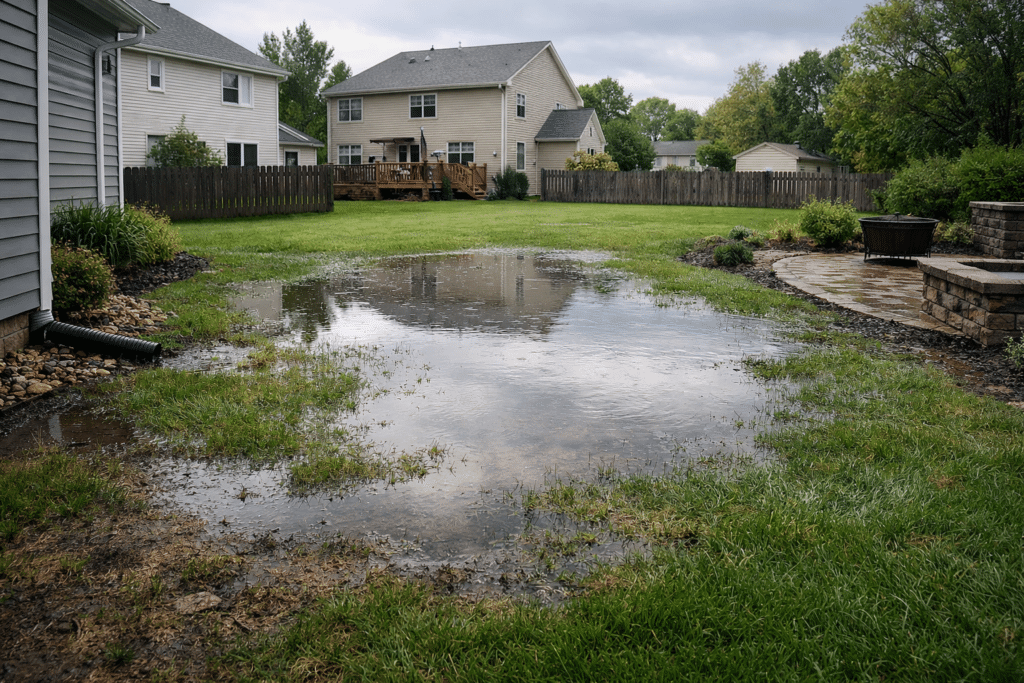
If you are dealing with water pooling near house after every rain or water pooling near patio that keeps the yard soggy, you are not alone. The good news is that most drainage headaches come from a few repeat causes, and the best fix is usually clear once you identify what is feeding the puddle.
This guide focuses on backyard drainage solutions that contractors use every day, including grading, downspout routing, French drains, catch basins, and smart discharge planning. The goal is simple: move water away from structures and hardscapes, then release it somewhere it can safely flow or soak in without creating a new problem.
You will also see a practical decision guide that matches symptoms to solutions, plus DIY steps you can do quickly when you need relief now. When you are ready for a professional plan, Land and Lawn can help homeowners across St. Charles, Illinois diagnose the cause and build a fix that lasts.
Table of Contents
Why does water pool in yards in St. Charles, Illinois?
Big picture: Water pools when more water enters a spot than can leave it. That sounds obvious, but it helps you troubleshoot because every drainage fix is really about changing one of three things: where water comes from, how fast it moves, or where it is allowed to exit.
In many neighborhoods across St. Charles, Illinois, yards can be surprisingly flat, and soil can be slow to absorb water. When runoff from roofs, patios, and driveways meets a low spot or compacted soil, standing water forms and lingers, especially after heavy rains or rapid snowmelt.
Here are the most common contributors homeowners run into:
- Wrong slope near the foundation: Even a small reverse pitch can push water toward the house instead of away. Many standards recommend sloping soil away from the foundation for the first several feet to keep the surrounding soil from saturating. [1][2]
- Compacted soil and fill: Construction backfill, foot traffic, and equipment can compress soil, reducing pore space and infiltration. Water then stays on the surface longer.
- Clay-heavy or fine soils: These tend to drain more slowly than sandy soils, so puddles can last longer after storms.
- Roof runoff dumping in one spot: A single downspout can move a lot of water quickly. If it discharges beside the foundation, it can create a recurring wet zone.
- Hardscape runoff: Patios, walkways, and edging can act like small dams. If there is no path for runoff, the lowest point becomes a basin.
- No safe outlet: If your yard is boxed in by fencing, neighboring grades, or minimal fall to the street, water may have nowhere to go without a planned swale or drain.
A helpful way to think about it is this: puddles are usually not the problem. Puddles are the symptom. The real issue is the water path.

How can you tell where the water is coming from (roof runoff, grading, soil, or hardscape)?
Start with observation: The fastest diagnosis comes from watching the yard during a rain (or right after). You are looking for the first place water concentrates and the direction it tries to travel.
A simple process that works for most homes:
- Mark the problem area. Put a small flag or stake at the center of the puddle.
- Look uphill. Water almost always arrives from higher ground, roof edges, or hardscape.
- Follow the downspouts. Confirm where each downspout actually discharges and whether the water runs back toward the house.
- Check surface slope. Use a long level, string line, or a straight 2×4 with a level to see if the ground pitches toward the puddle.
- Check hardscape pitch. Patios should shed water away from the house. If water runs toward the foundation or collects at an edge, the patio surface may be part of the problem.
- Test infiltration. After a rain, if the whole lawn feels spongy and footprints fill with water, the issue may be saturated soil or a high groundwater condition rather than a single low spot.
Here is a quick diagnostic table you can use on-site:
| What you see | Most likely source | Quick confirmation | Most common fix |
|---|---|---|---|
| Puddle forms right under a gutter drop | Roof runoff | Watch the downspout during rain | Extend or bury the downspout line |
| Wet ring around the house, mulch washes out | Grading toward foundation | Level shows pitch toward home | Regrade and add downspout control |
| Low spot stays wet even when it does not rain | High groundwater or poor soil drainage | Soil stays saturated below the surface | French drain or underdrain with outlet |
| Water collects at patio edge or corner | Hardscape runoff | Hose test shows flow to that corner | Surface drain or catch basin |
| Wet area near discharge pipe from basement | Sump discharge | Run sump and watch where it exits | Extend discharge to a safer location |
If you want more context on how patios and walkways affect drainage direction, the internal post The Ultimate Guide to Hardscaping is a useful companion read.
What are the fastest DIY fixes for standing water in a yard?
If you searched “how to fix standing water in yard”: Start with the fixes that reduce incoming water and reopen a surface path for runoff. Fast DIY wins usually come from roof runoff control and small grading tweaks, not from digging a long trench first.
A practical way to prioritize is by time and effort:
Quick Relief Chart (Time vs Impact)
- 30 to 90 minutes: Clean gutters, clear downspout elbows, remove debris dams, extend a downspout temporarily
- Half day: Add a splash block, reshape a small swale with a rake and soil, topdress a shallow low spot
- Weekend: Install a short buried downspout line, build a simple surface drain run, improve a compacted area with core aeration
Fast DIY steps that often help immediately:
- Clear the obvious flow blockers. Leaves at patio edges, mulch piled against the house, and clogged downspouts can all create pooling.
- Temporarily extend downspouts. Even a basic extension can stop the same spot from being hit with roof runoff over and over. [5]
- Create a shallow surface path. A small swale is just a gentle channel that gives water a preferred route. Keep it wide and shallow so it can be mowed.
- Topdress minor low spots. Use soil to bring the low spot up in thin layers over time, then reseed. Avoid burying grass under a thick layer in one shot.
- Protect the foundation zone. Soil should not slope toward the house. If it does, a small regrade near the perimeter is often a high-value fix. [1][2]
Common DIY mistakes to avoid:
- Digging before locating utilities: Always contact 811 a few business days before you dig so buried utilities can be marked. [3][4]
- Assuming gravel alone fixes drainage: Gravel can reduce mud on the surface, but it does not change slope or provide an outlet.
- Sending water to the wrong place: Redirecting water toward a neighbor or into a place where it will freeze or erode can create bigger issues later.
For homeowners who want a more nature-forward approach in addition to drainage hardware, Rain Garden Landscaping can help you understand when infiltration-based landscaping makes sense.
When should you extend downspouts or install a buried downspout drain line with a pop-up emitter?
Roof runoff is high volume: During a heavy rain, your roof sheds water fast, and downspouts concentrate that water into a few discharge points. If one of those points is near the foundation, it can contribute to seepage, soil settlement, and recurring puddles.
You should strongly consider downspout changes when you notice any of these:
- Splashing or erosion where the downspout hits the ground
- Repeated wet mulch beds along the house
- Water running back toward the foundation after discharge
- A constant soggy strip along the home line
Extension vs burial: An above-ground extension is often the fastest first step. A buried line becomes the better option when you need to cross a sidewalk, keep the yard cleaner, or move water farther without creating a trip hazard.
Discharge distance rules vary by property layout, but many guides recommend terminating roof runoff at least about 5 feet from the foundation, and farther when using an underground catchment approach. [5] In basements or lower-level homes, some guidance recommends keeping discharge at least about 6 feet away from basement walls and always within your property limits. [6]
If you are specifically looking for a downspout drain line to yard solution, a standard setup is:
- Downspout adapter to solid pipe (not perforated)
- Cleanout access at a logical spot
- Proper slope along the run where possible
- Outlet to daylight using a pop-up emitter
A pop-up emitter is a surface outlet designed to open under water pressure and close afterward, helping keep debris out. Some installation details include using an elbow with a weep hole and orienting it correctly so standing water can drain between storms. [7]
Common installation mistakes contractors see:
- No cleanouts: Leaves and shingle grit can clog lines, especially if gutters are not maintained.
- Perforated pipe used for roof water: Roof water should usually be carried in solid pipe to the outlet so it does not saturate soil along the run.
- Outlet placed in a low spot: If the emitter is lower than the surrounding grade, it becomes a mini pond.
- Discharging into a neighbor-facing side yard: Water must remain on a safe path and should not create issues next door. [2][6]

When is yard grading and leveling the best solution for drainage problems?
Grading fixes root causes: If water is moving the wrong direction across the yard, adding drains alone can treat symptoms while the slope continues to send water where you do not want it. Yard grading and leveling is the best solution when you have broad, slow puddling across large areas, or when the yard pitches toward the home.
A key concept is perimeter protection. Many building standards emphasize that the ground near the home should slope away to reduce saturation at the foundation. [1][2] In practice, this can mean reshaping soil so water naturally moves away instead of relying on a pipe to do all the work.
Situations where grading is usually the right first move:
- The yard slopes toward the house on one or more sides
- Multiple puddles appear across the yard rather than one low spot
- Water follows the same path toward the patio or basement window wells
- The soil line has settled along the foundation, creating a trough
Situations where grading alone may not be enough:
- Your yard has no downhill outlet and stays saturated below the surface
- A low spot is fed by runoff from roofs or hardscapes that needs to be captured
- You have persistent groundwater seepage (not just surface runoff)
Cost factors: Grading costs vary widely because the work depends on how much soil needs to be moved and what must be restored afterward. The biggest cost drivers are access (can equipment reach the area), how much recontouring is needed, whether new topsoil is required, and whether you need sod, seed, or landscape repairs after shaping.
A practical check before committing to grading is to do a hose test and verify where the water wants to go once you give it a gentle path. If the yard cannot “escape” to a safe outlet, grading should be paired with another solution like a swale, yard drain, or planned discharge.
Is a French drain the right option for your yard drainage issue?
What it is: A French drain is a gravel-filled trench that typically includes a perforated pipe wrapped in fabric so water can enter and be carried away along a sloped path. [9][10] It is designed to intercept water in saturated soil and give it a lower-resistance route to a discharge point.
A quick bit of history: the concept was popularized in the 1800s and has been used for everything from farm fields to residential yards. [10] The core idea has not changed, but good installation details matter a lot.
A French drain is often a good fit when:
- You have a soggy lawn area that stays wet long after rain
- Water seeps from a hillside or higher neighbor lot toward your yard
- The problem is not just one surface puddle, but overall soil saturation
A French drain is often a poor fit when:
- You have no way to drain the line downhill to a safe outlet
- The problem is mostly surface runoff collecting in one spot (a surface inlet may be better)
- You are trying to handle large roof runoff volumes without pretreatment
How it needs to work: Gravity and outlet planning are everything. Many drainage specifications call for maintaining a consistent slope to an outlet, with a minimum slope often around 0.5% for reliable movement. [8] Without slope and a real discharge location, a French drain can become an underground water storage trench.
Here is a simple quality checklist that separates long-lasting installs from short-lived ones:
- Perforated pipe sized appropriately for the job (4-inch is common in many specs) [8][9]
- Washed gravel around the pipe to create void space for water flow [9]
- Fabric separation to reduce soil migration into the gravel and reduce clogging [9][10]
- A defined outlet location that can accept water without causing erosion
Cost factors: The biggest factors are trench length, digging conditions (roots, tight access, existing utilities), outlet feasibility, and restoration (sod, seed, or landscape rebuilding). When homeowners compare bids, the most meaningful differences are usually materials, outlet design, and how the contractor plans to prevent clogging.
When should you use a catch basin or yard drain instead of a French drain?
Surface water needs a surface inlet: If you can see water flowing across the ground and pooling in a specific low spot, a catch basin or yard drain is often the cleaner solution. These are designed to collect surface runoff at a grate and send it into a solid pipe system.
A catch basin typically includes a grate where water enters and a sump below that helps capture sediment and debris before water moves into the outlet pipe. [13][14] That sump is useful, but it also means maintenance is part of ownership.
Use a catch basin or yard drain when:
- Water funnels to one point between homes
- You get water pooling near patio edges or corners
- Downspouts dump into a low spot and overflow during storms
- You need to capture runoff before it crosses a walkway
Use a French drain when:
- The yard is broadly saturated and you want to intercept water within the soil profile
- You need to relieve wet zones along a slope or retaining wall line
A quick comparison that helps decision-making:
| System | Best at handling | Main limitation | Maintenance reality |
|---|---|---|---|
| Catch basin / yard drain | Surface pooling at a low spot | Needs proper pipe outlet and clean placement | Grate and sump can collect debris and must be cleaned |
| French drain | Saturated soil and subsurface water movement | Needs slope and a real discharge point | Can clog over time if fabric and gravel are wrong |
If hardscape layout is part of why water is concentrating, revisit The Ultimate Guide to Hardscaping to understand how surface pitch and edging details affect drainage paths.

What should you know about sump pump discharge drainage (and where it should go)?
This is a common hidden cause: Sump discharge drainage is supposed to move groundwater away from the home. But if the discharge line ends too close to the foundation or dumps into a flat area, it can recycle water right back toward the house or create a permanent soggy patch.
A safe, practical goal is to discharge to a location that is downhill or at least clearly away from the foundation, and that does not create erosion or nuisance water for neighbors. [5][6]
Two important cautions:
- In many communities, sump pumps should discharge to the yard or to an approved storm system, not into sanitary sewer piping. [11][12]
- If your discharge line runs across a walkway or driveway, it can freeze and become a hazard in winter conditions.
A clear do and do not list helps:
- Do: Extend discharge far enough that water cannot flow back toward the home, and route it to a spot that can safely accept repeated water.
- Do: Check the end of the line during heavy rain to confirm it is not overwhelmed.
- Do not: Tie discharge into sanitary plumbing, even if it seems convenient. [11][12]
- Do not: Dump discharge at the base of a slope where it will erode soil and expose roots.
If your property can support infiltration-based options, a properly located rain garden or infiltration feature can sometimes work as part of a plan, but it must be sited carefully away from the foundation. [16] For a landscape-focused approach, Rain Garden Landscaping provides useful context.
How do you choose the right backyard drainage solutions for your exact problem (near house, near patio, low spot, or soggy lawn)?
Use symptoms to pick the tool: The “best” drainage system depends on what kind of water you are dealing with and where it concentrates. Surface pooling calls for capturing and redirecting water at the surface. Saturated soil calls for intercepting water below grade and giving it an outlet. Wrong slope calls for grading first.
Here is a decision guide that matches common homeowner complaints to the most likely fix:
| Problem area | What it usually means | Best first step | Most common long-term fix |
|---|---|---|---|
| Water pooling near house | Downspout discharge or grading toward foundation | Extend downspouts, check slope | Regrade perimeter plus controlled discharge |
| Water pooling near patio | Hardscape runoff concentrating at edge | Hose test to confirm flow path | Catch basin or surface drain tied to outlet |
| Low spot in lawn | Localized depression or settlement | Topdress and reshape surface path | Small swale, yard drain, or regrading |
| Wide soggy lawn area | Soil saturation, poor infiltration, or groundwater | Confirm outlet feasibility | French drain or underdrain with slope and outlet |
A simple rule that prevents most wrong installs:
“If you cannot describe where the water will exit, you do not have a drainage plan yet.”
If you want a professional diagnosis that is based on how water actually behaves on your property, request a site visit with Land and Lawn. A good plan usually combines two or more tactics, like downspout control plus grading, or a surface inlet plus a subsurface line.
When should you call a drainage contractor in St. Charles, Illinois?
DIY is great for small fixes, but not for system design: The moment your drainage issue involves multiple water sources, tight property constraints, or work near structures and utilities, you usually get better results with a contractor plan.
Consider calling a pro if any of these are true:
- Standing water remains for more than a day or two after typical rain
- You have recurring basement moisture or seepage
- Your yard needs significant recontouring to change drainage direction
- The solution requires running pipe under sidewalks, patios, or tight side yards
- You need to confirm a code-compliant discharge approach and avoid impacting adjacent property [2]
- You are planning French drain installation St. Charles, Illinois and want to be sure there is proper slope and an outlet [8][9]
- You are searching “yard grading and leveling near me” because the yard clearly slopes the wrong way
- You are searching “drainage contractor near me” because you want the problem diagnosed and fixed correctly the first time
Short CTA: If you are in St. Charles, Illinois and want a clear plan without guesswork, contact {BUSINESS_NAME} to schedule an estimate and on-site drainage evaluation. The fastest fixes often come from finding the true water source and correcting the water path, not from adding more gravel.
If patio runoff is part of the project, the internal post Patio Cost Estimate for Spring Installs can help you plan the timing and scope alongside drainage improvements.

What yard drainage questions do homeowners ask most often?
FAQ overview: These are the questions homeowners bring up most when they are trying to stop yard flooding and protect their home. The short answers are helpful, but the best results still come from matching the fix to the cause.
How long is it normal for water to sit in the yard after rain?
A small puddle right after a heavy storm can be normal, but water that sits for extended periods is a sign that the soil cannot drain fast enough or the surface has no outlet.
If the same area stays wet after most storms, treat it as a drainage-path issue and work backward to identify whether roof runoff, grading, or soil saturation is feeding it.
Can I just add soil on top of a low spot and be done?
Sometimes, yes, if the low spot is shallow and not being fed by a downspout or hardscape runoff. Layering soil gradually can restore surface slope without smothering turf.
The common mistake is filling a low spot without fixing the inflow. If a downspout is dumping there, it will simply create a new low spot over time.
Will a French drain fix water pooling near patio?
It depends on whether the patio problem is surface runoff or saturated soil. If water is visibly flowing across the patio edge and collecting, a surface inlet like a yard drain or catch basin is often the more direct solution. [13][14]
French drains can help when the area beside the patio stays saturated below the surface and needs a subsurface outlet, but they still require slope and a discharge plan to work. [8][9]
Should I connect downspouts and sump discharge into the same buried line?
In some layouts, combining flows can work, but it must be sized and routed so it does not overwhelm the line or dump water in a place that creates a new problem. Roof runoff can be high volume during storms, and sump discharge can add steady flow.
Also, discharge rules matter. Many communities restrict where sump and stormwater flows can go, and sanitary connections are commonly prohibited. [11][12]
Where should sump discharge drainage go if my yard is flat?
A flat yard is not a dead end, but it does require a deliberate plan. Options can include routing to a safe daylight outlet, directing flow to a properly designed swale, or using an infiltration feature that is sited appropriately away from the foundation. [5][15][16]
The key is avoiding recycling water back toward the home and avoiding nuisance water for neighbors. In flat lots, small grade changes and surface shaping are often paired with piping.
What maintenance do drainage systems need?
Downspout lines need gutter and debris control so sediment does not accumulate. Pop-up emitters and outlet points should be checked for blockage after storms. [7]
Catch basins need periodic cleaning because the sump is designed to collect debris and sediment. If the sump fills, the system loses capacity and can back up during storms. [13][14]
Final CTA: If you want a contractor to identify the real cause and recommend the simplest long-term fix, schedule a site visit with Land and Lawn. We serve homeowners across St. Charles, Illinois and can provide an estimate and a clear drainage plan tailored to your yard layout.
Key Takeaways
- Standing water is a symptom; the lasting fix comes from identifying the water source and correcting the water path.
- Downspout control and proper grading near the foundation are often the fastest, highest-impact drainage improvements.
- French drains solve saturated-soil problems when there is slope and a real outlet; catch basins solve surface pooling at low spots.
- Sump discharge must be routed so it does not recycle water back toward the home and should not be tied into sanitary piping where prohibited.
References
Foundation Drainage Standards
[1] Final Grade Slopes Away from Foundation. Building America Solution Center. Published September 30, 2020. (Accessed February 25, 2026)
[2] 780 CMR, CHAPTER 51, ch. R4, R401.3 – Drainage. (Accessed February 25, 2026)
Utility Dig Safety
[3] 811 Before you dig. Every dig. Every time. (Accessed February 25, 2026)
[4] Call 811 Before You Dig. (Accessed February 25, 2026)
Roof Runoff Management
[5] Stormwater Gutters Downspouts. Building Science Education. (Accessed February 25, 2026)
[6] Minimizing Stormwater Runoff by Disconnecting Residential Downspouts. (Accessed February 25, 2026)
[7] Downspout Water Drainage System (Installation Instructions PDF). (Accessed February 25, 2026)
French Drains and Specs
[8] Gravel Drainage Specifications. (Accessed February 25, 2026)
[9] French Drain for Overworked Rain Garden (Ask Extension FAQ). Published June 23, 2025. (Accessed February 25, 2026)
[10] What Is a French Drain? (Accessed February 25, 2026)
Sump Discharge Guidance
[11] Proper Sump Pump Installation. (Accessed February 25, 2026)
[12] Sump Pump Discharge Informational Packet (PDF). (Accessed February 25, 2026)
Catch Basins and Drains
[13] Best Management Practices to Maintain Catch Basins to Prevent Pollution. (Accessed February 25, 2026)
[14] Catch Basins: Where Does Our Water Go? (PDF). (Accessed February 25, 2026)
Swales and Infiltration
[15] Water-Quality Swales: Low-impact development fact sheet. (Accessed February 25, 2026)
[16] Dry Well (PDF). (Accessed February 25, 2026)