
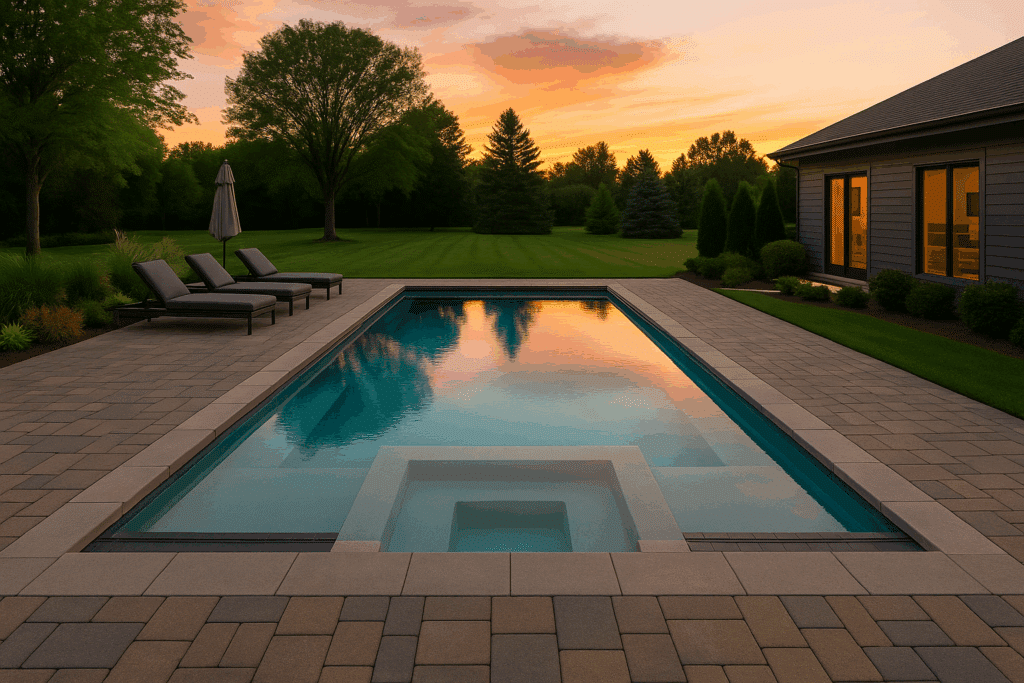
Intro — Design Shapes That Fit Your Life 🧩
Choosing a pool shape is as much about lifestyle as it is about looks. Clean lines favor lap swimming and automatic covers, while curves carve out playful shallows, tanning ledges, and organic views. In Illinois, where summers are precious and lots vary from compact suburbia to acreage, the right form can stretch how (and how often) you use the water. The best design harmonizes with sun paths, prevailing winds, and your intended activities—from laps and cannonballs to quiet floating and stargazing.
Your yard’s geometry, house architecture, and hardscape plan should steer the decision. A formal home often pairs beautifully with rectangles and Roman/Grecian ends; wooded lots and prairie plantings complement freeform silhouettes. Budget, maintenance, safety, and energy choices also flow from shape: some forms accept automatic covers and robotic cleaners more easily, while others emphasize integrated seating, splash zones, or vanishing edges. This guide breaks down the major options with Illinois realities in mind, so you can pick confidently.
Table of Contents
How to Choose Inground Pool Shapes in Illinois 🧭
Start with purpose. If fitness is first, uninterrupted lanes and predictable wall returns matter; if family play dominates, shelves, benches, and a generous shallow end take priority. Next, study the site: most pools perform best with long sides aligned to sun, wind, and sightlines from indoor rooms. In Chicagoland, consider frost depth for structures around the pool and plan decking bases accordingly [11]. Safety barriers and cover compatibility should be baked into design from day one, not added after construction [3][10].
Finally, match material to shape and timeline. Fiberglass shells deliver fast installs and silky finishes but limit you to manufacturer molds; concrete unlocks nearly any geometry and detail at the cost of longer schedules and maintenance; vinyl liners balance price and feel but need periodic replacement [9][6]. Map those tradeoffs against budget and how long you’ll live in the home. With priorities clear, the right form usually reveals itself.
Rectangles — Clean Lines & Lap‑Friendly 🏊♀️
Rectangular pools are timeless for a reason: they maximize swimmable area, simplify lane swimming, and stage furniture symmetrically on deck. Their straight edges mate neatly with paver or concrete patios and make automatic safety covers straightforward to add—often at lower complexity than irregular forms [1][14]. If you envision early‑morning laps or teen water polo, rectangles give you predictable walls and a consistent centerline that keep training simple [7]. They’re also camera‑friendly—great for real estate photos and resale.
Functionally, rectangles tend to be easier to skim and vacuum because debris tracks predictably along edges. Lighting design is simpler too—linear runs along long walls and steps. Want resort polish? Add a full‑width tanning ledge, integrated spa at one end, and a run of low‑voltage lights beneath capstones. If your backyard is narrow, a long, slender rectangle creates a striking “water corridor” without feeling cramped, while still leaving room for a small dining terrace.
Freeform Pools — Natural, Landscape‑Forward 🌿
Freeform pools mimic ponds and coves, curving gracefully to nestle into gardens. They excel where you want sweeping plant beds, boulders, or a lagoon vibe. Because the outline meanders, you can carve kid shallows, hidden benches, and rock waterfalls without visual clutter. Many homeowners favor the organic ambiance and how the water mirrors surrounding foliage and stonework [1][3]. If your home skews rustic or your property backs to woods, freeform reads “native” rather than “built.”
Designers often pair freeform shells with varied deck textures—exposed aggregate, stone inlays, or wood-look porcelain—to keep the eye moving. One tradeoff: automatic safety covers and lap lanes are less straightforward, so plan for alternative safety solutions and maintenance tools. Think strategically about skimmers and returns to keep circulation even around curves. Done well, a freeform pool feels like it emerged from the landscape itself.

Kidney & Figure‑8 — Mid‑Century Flow ☯️
Kidney shapes deliver a gentle pinch that divides activity zones: shallow play or a tanning shelf on one lobe, deeper water on the other. The asymmetry creates natural focal points for a fire pit, dining set, or specimen tree. The style surged to popularity in mid‑century America and ties back to European modernism—Alvar Aalto’s work and the iconic Donnell Garden helped set the template [2]. If you love Eames chairs, breezeblocks, and warm wood tones, this look clicks.
Figure‑8 pools push the pinch further, emphasizing two distinct circles with a waist that’s ideal for steps or a spillover spa. Both styles read soft and approachable, especially in family yards. They also accommodate a surprising amount of bench seating along inside curves. As with freeform, your contractor should tune circulation so returns sweep debris toward skimmers around the neck efficiently.
Roman & Grecian Ends — Formal Symmetry 🏛️
Roman and Grecian profiles riff on rectangles by doubling semicircles or clipped corners at the ends. The result is stately and architectural—perfect with columned pergolas, symmetrical planting, and masonry steps. If your patio is already organized by axes (door‑to‑garden, kitchen‑to‑lawn), these shapes reinforce the order. They’re also friendly to integrated spas: a raised half‑round spa can perch on the end and spill into the main pool with dramatic effect.
Because they keep mostly straight walls, these designs retain many rectangular perks—efficient lighting and cover options—while softening the look. Consider shallow radiused steps across one end for grand entry, leaving the opposite end for deep water or a swimout bench. Classic stone coping, clipped boxwood, and path lighting complete a formal tableau that still swims beautifully.
L‑, T‑ & Geometric Hybrids — Zone Your Fun 🔀
When you want clear “rooms” in the water, hybrid geometries shine. An L‑shape separates play from laps or sets up a shallow tanning arm beside a deeper main body. A T‑shape can nudge swim lanes away from a busy steps area. These lines also tuck neatly around architecture—garages, patios, or outdoor kitchens—creating intuitive circulation on deck.
Hybrids excel on corner lots and narrow yards where a pure rectangle would either dominate or leave awkward dead zones. They also make furniture planning easy: chaise lounge banks along one leg, dining on the other. Add a bench inside the corner for conversation. Because hybrids keep straight segments, they stay friendly to covers and cleaners compared to fully organic forms.

Small Yards — Plunge, Cocktail & “Spools” 🥂
If your lot is compact or you simply want less water to maintain, small-format pools deliver big enjoyment. Plunge and cocktail pools (often 10×20 ft or smaller) provide cooling dips, hydrotherapy benches, and space for aquatic exercise bands without sacrificing the entire yard. Spools (spa‑pool combos) layer heat and jets for shoulder‑season comfort. Material choice and dimensions drive cost: national estimates put typical shell costs per square foot roughly around vinyl ($130–$240), fiberglass ($175–$330), and concrete ($200–$350), exclusive of decking and fencing [9].
For mini footprints, multitask every inch: a full‑width bench doubles as a conversation ledge; a 12–18‑inch tanning shelf hosts toddlers by day and loungers by evening; corner steps keep the center open. With clever lighting and mirrors of stone in the hardscape, small water can feel luxurious, not compromised.
Materials Drive Flexibility — Fiberglass, Concrete, Vinyl ⚙️
Your shape decision intersects with material reality. Fiberglass arrives as a one‑piece shell, prized for smooth finishes and quick installation; the tradeoff is you’ll select from pre‑made molds, though today’s catalogs cover rectangles, freeform, and more [1][6]. Concrete (shotcrete/gunite) is the sculptor’s medium—if you can draw it, a skilled builder can form it—ideal for complex curves, vanishing edges, and custom depths. Vinyl liners stretch over steel or polymer walls; they offer value and a comfortable feel, with periodic liner replacement part of lifecycle planning [9].
Maintenance, lifespan, and add‑on compatibility differ by type. Automatic covers pair easily with straight tracks; textured tanning ledges demand careful surface choices; darker interiors warm faster but may show scaling sooner. Energy choices matter, too: variable‑speed pumps can cut electricity use substantially compared to single‑speed models, especially when run at lower speeds for filtration [5][18]. Build the energy plan with the shape, not after.
Placement, Sun, Wind & Safety in Illinois 🌞🍃
Great pools choreograph sun and shelter. Aim to capture midday sun on the main body while providing shade retreats nearby. Study prevailing winds; orient returns and skimmers to help (not fight) surface cleaning. In Illinois, frost depths commonly require deeper footings for adjacent structures such as pergolas and walls—local jurisdictions like Rockford specify 42 inches below grade for frost footings [11]. Account for these bases in early layouts so coping, steps, and deck elevations align cleanly.
Safety is non‑negotiable. Plan for compliant barriers, gates, and latch heights before you pick furniture and planters. The U.S. Consumer Product Safety Commission publishes clear residential pool barrier guidelines—while not a federal “code,” they’re widely followed and help reduce incidents [3][10][16]. If you’re considering an automatic cover, confirm it suits the selected shape and integrates with coping details. Good safety is seamless and beautiful when designed in from the start.
Budget & Timeline — How Shape Influences Both ⏱️💵
Complex curves, raised walls, and integrated features (sheer descents, spas, sun shelves) add time and cost. Simpler rectangles typically install faster and accept automatic covers and straight coping with fewer specialty cuts. Material costs vary by shell type and size; national estimates per square foot show vinyl on the lower end, fiberglass midrange, and concrete highest, excluding decks, utilities, and fences [9]. Regional market conditions and features like retaining walls, lighting, and landscaping can move totals dramatically [6].
Installation windows also depend on scope and weather. Consumer guides place typical in‑ground timelines in the range of several weeks to a few months from permits to fill, depending on material and inspections, with add‑ons extending schedules [79][80]. In Illinois, spring rains and freeze‑thaw shoulder seasons can influence excavation and decking calendars. Lock design early and order long‑lead items to stay on track.

Bring It Together — Your Best‑Fit Shape ✨
Rectangles reward swimmers and minimalists; freeform and kidney shapes melt into gardens; hybrids zone play and laps; small formats unlock tiny lots. The “best” choice is the one that elevates how you live—day after day, season after season. Sketch your must‑dos, walk the yard at different times, and imagine sightlines from kitchen, family room, and patio. Then match material, safety, and energy plans to that picture so the finished pool performs as beautifully as it looks.
When you’re ready to turn plans into water and light, a trusted local builder can translate vision into details that last in Illinois’ climate. Since 1998, Land and Lawn Services has crafted integrated outdoor spaces—pool, patio, planting, lighting, and drainage—so everything works together. If you want a shape that swims right and photographs beautifully, we’re ready to help.
Key Takeaways
- Let purpose drive shape: laps vs. lounging vs. play.
- Rectangles maximize lanes and cover compatibility [1][14].
- Freeform/kidney integrate naturally with landscape [1][2][3].
- Material affects flexibility, cost, and schedule [9][6].
- In Illinois, plan safety barriers and frost‑depth footings early [3][11].
References
[1] Latham Pools. “Rectangle Shaped Inground Pools — Benefits & Features.” https://www.lathampool.com/rectangle-shaped-pools/
[2] Dwell. “The Rise of the Kidney-Shaped Pool and Its Unexpected History.” https://www.dwell.com/article/kidney-shaped-pools-skateboarding-c3493888
[3] U.S. Consumer Product Safety Commission. “Safety Barrier Guidelines for Residential Pools (PDF).” https://www.cpsc.gov/s3fs-public/362%20Safety%20Barrier%20Guidelines%20for%20Pools.pdf
[5] U.S. Department of Energy, Energy Saver. “Choosing, Installing, and Operating an Efficient Swimming Pool Pump.” https://www.energy.gov/energysaver/choosing-installing-and-operating-efficient-swimming-pool-pump
[6] River Pools & Spas. “Inground Swimming Pool Cost & Pricing Guide.” https://www.riverpoolsandspas.com/inground-pool-cost-guide
[7] Cox Pools. “Rectangular Pools Are Making A Comeback: 6 Reasons Why.” https://coxpools.com/rectangular-pools-are-making-a-comeback-6-reasons-why/
[9] This Old House (2025 Guide). “How Much Does an Inground Pool Cost?” https://www.thisoldhouse.com/home-finances/inground-pool-cost
[10] CPSC. “Safety Barrier Guidelines for Home Pools (web page linking to PDF).” https://www.cpsc.gov/safety-education/safety-guides/pools-and-spas/safety-barrier-guidelines-home-pools
[11] City of Rockford, IL. “How deep must frost footings be? (42 inches below grade).” https://rockfordil.gov/FAQ.aspx?QID=80
[14] Thursday Pools. “Rectangular Pool Benefits.” https://thursdaypools.com/blog/rectangular-pool-benefits/
[16] Pool Safely (CPSC Campaign). “Pool Safely.” https://www.poolsafely.gov/
[79] Better Homes & Gardens. “Here’s Everything You Should Consider When Planning for a Pool.” https://www.bhg.com/home-improvement/outdoor/pools-spas/planning-for-a-pool/
[80] Architectural Digest. “Want a Pool Installed by Next Summer? Here’s Where to Get Started.” https://www.architecturaldigest.com/story/want-a-pool-installed-by-next-summer-where-to-get-started