
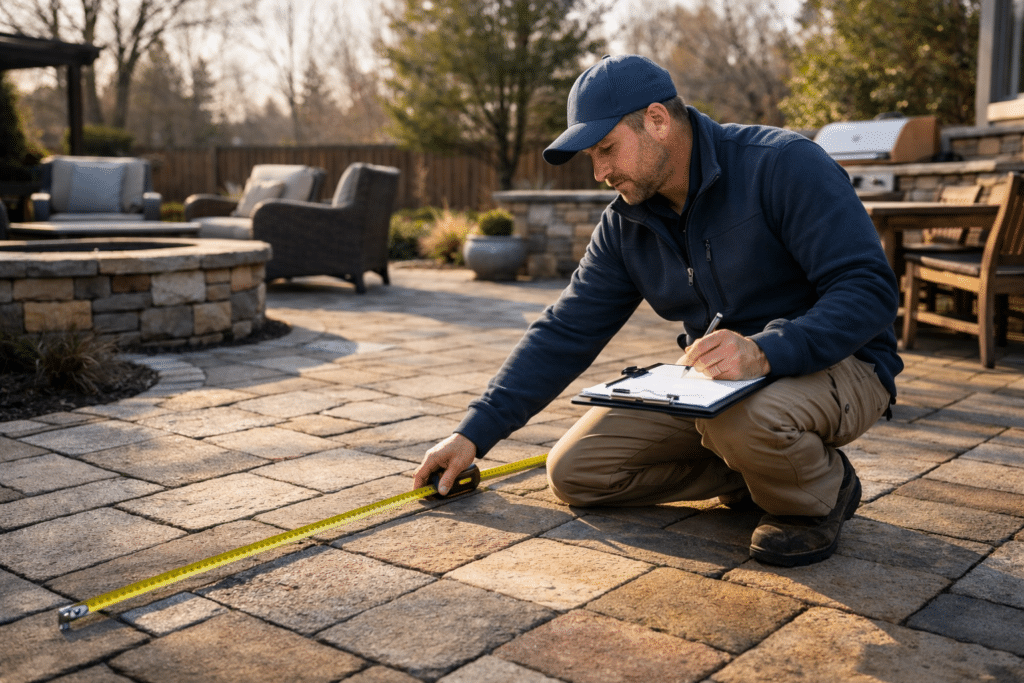
Patio cost estimate is the fastest way to turn a spring patio idea into a scheduled build in {CITY}, {STATE} and nearby areas. As soon as the weather starts to break, calendars fill quickly for patio installation and patio rebuild work, so getting a clear scope and a written plan early helps you lock in the best schedule windows before they disappear.
Most homeowners also start with common language, not industry terms. They search for stone patio cost, brick patio cost, patio pavers cost, or just “how much is a patio” because they want a number that feels real enough to make decisions. This guide explains what drives pricing, what an on-site estimate should include, and how to book now without rushing into the wrong build.
Quick promise: You will not see a single magic number that fits every yard. You will see how to build an accurate estimate, what questions to ask, and which choices change the price the most.
Table of Contents
Book now: why spring patio schedules fill early
Weather windows: Outdoor construction is sensitive to moisture and temperature. Even when crews are ready, the ground and the materials still need cooperative conditions. That is why spring schedules tend to compress into short, high-demand windows, especially after rainy stretches.
Decision lag: Many projects get delayed because homeowners wait to “see how spring goes.” Then they try to schedule once they have hosted one gathering or noticed one problem area. By that point, the most convenient dates may already be booked, and you may be choosing between later dates or compromising on scope.
Compact scheduling chart (typical pattern, not a promise):
Late winter to early spring: Measure, pick materials, choose layout, schedule an on-site estimate
Mid spring: Demolition and base work as weather allows
Late spring: Surface install, finishing details, final cleanup
Early summer: Add-ons like seating walls, lighting, or upgrades as a second phase
Mini-summary: If your goal is to use the patio this season, booking the estimate early is the step that gives you the most control.
Here are the fastest actions that create momentum without committing to the full project:
- Take photos of the existing patio and any low spots or puddling
- Mark the edges of the area you want with a hose or chalk
- List the must-haves (steps, border, fire feature, walkway connection)
- Decide if you are rebuilding in the same footprint or changing the size
- Request an on-site estimate and ask about spring availability

Patio cost estimate: what it covers and how to compare quotes
A Patio cost estimate should answer two questions at the same time: what is included, and what could change once the work starts. Many pricing tools show a “basic cost” range that can vary by location and options, which is helpful for early budgeting, but it is not a substitute for a site-based scope. [1] [2] [4]
What “estimate” should mean: A strong estimate is a short document that defines the build method, the materials, the square footage, the edge details, the drainage assumptions, and the timeline expectations. It should also be clear about what is excluded, such as hidden base failures under large existing slabs or unexpected utility conflicts.
Table: what a solid estimate usually includes
| Scope element | What it tells you | Why it matters |
|---|---|---|
| Measured area | Square footage and shape | Size is the main driver of material and labor [13] |
| Demolition plan | Remove old surface or build over | Tear-out vs overlay changes time, disposal, and risk |
| Base plan | Depth, compaction approach, materials | Base quality drives longevity and settling risk [11] |
| Edge restraint plan | How edges are locked in | Edges resist creeping and joint loss over time [5] [6] |
| Drainage assumptions | How water leaves the patio | Water issues often expand scope and cost [3] |
| Surface materials | What the visible surface is | Material choice affects labor and long-term care [1] [4] |
| Joint plan | Joint material and finish | Joint decisions affect weeds, washout, and maintenance [10] |
| Add-ons | Steps, border, seating, lighting | Details can add time and cutting complexity |
| Timeline | Start window and duration | Sets expectations for spring scheduling |
| Warranty and care | What is covered and what is maintenance | Clarifies responsibilities after install |
The most important comparison rule: Compare scope before you compare price. Two bids can look similar until you notice that one includes deeper base work, edge restraint details, or drainage corrections, while the other assumes the existing conditions are perfect.
Quote to listen for during the walkthrough: “The edge detail is not optional if you want long-term stability.” [5] [6]
What drives the price
Most patio pricing comes down to three categories: site work, labor complexity, and materials. Cost calculators that publish baseline ranges consistently note that local conditions and options can move the final price significantly. [1] [2] [4]
Cost driver 1, size: Bigger patios need more excavation, more base, more surface material, and more time. The relationship is not always perfectly linear because small projects still have mobilization, cutting setup, and cleanup time.
Cost driver 2, access: If materials have to travel through a narrow gate, around landscaping, or up and down steps, labor time goes up. Access also influences whether a small machine can be used or if the job becomes fully hand-carried.
Cost driver 3, demolition and disposal: Removing an old surface, hauling away debris, and disposing legally can be a meaningful portion of the scope. This is especially true if the old patio includes thick concrete or multiple layers.
Bullet checklist: conditions that usually increase scope
- Unlevel ground or visible drainage problems [3]
- Soft soils, heavy clay, or areas that stay wet
- Downspouts emptying near the patio edge
- Tree roots near the footprint
- Multiple elevation changes, steps, or landings
- Curves, circles, borders, and inlays
- Tight access to the backyard
- Add-ons like low walls, pillars, or built-in seating
Mini-summary: If you want a fast, accurate number, focus the on-site visit on access, drainage, demolition, and base strategy. Those are the items that are hardest to guess from photos.
Materials in everyday terms
Homeowners often say “stone patio” when they mean one of several different surfaces. Getting the words right helps you get the right estimate.
Stone patio: This can mean natural stone pieces set on a base, or it can mean manufactured stone-look units. Pricing tools commonly separate natural stone patio work from other surfaces, and the baseline range can differ depending on region and options. [4]
Brick patio: This can mean real clay brick, brick-style pavers, or concrete units shaped and colored to look like brick. Baseline pricing for brick paver patio work also varies widely by conditions and options. [2]
Pavers: In common language, pavers are individual units that lock together to form a patio surface. The big advantage is serviceability: individual units can often be lifted and reset if a section settles, instead of tearing out the entire patio. That same system depends on details like edge restraint and joint stability. [5] [6] [11]
Table: plain-language comparison
| What you call it | What it usually is | Best for | Watch-outs |
|---|---|---|---|
| Stone patio | Natural stone or stone-look units | High-end look, timeless feel | Requires solid base and drainage planning [4] |
| Brick patio | Brick-style units or clay brick | Classic style, strong curb appeal | Edge restraint and joints matter for long-term lines [5] [6] |
| Patio pavers | Concrete or stone units | Flexibility, patterns, easier spot repair | More cuts and borders can increase labor time |
Practical tip: Bring 2 to 3 inspiration photos to the estimate visit, but also be ready to describe how you want to use the space. Layout decisions should follow furniture and walking paths, not just a picture.
Site conditions and base work
If you only remember one thing about patios, remember this: the surface is the reward, but the base is the job. Industry technical guidance for interlocking surfaces emphasizes the role of base layers, bedding, and edge containment to support long-term performance. [11] [5]
Base depth and compaction: The depth of excavation and the quality of compaction are major drivers of both cost and durability. A patio that looks perfect on day one can still settle if the base is too shallow, not compacted correctly, or built over soft soil.
Drainage is not optional: If water has nowhere to go, it can pump fine material out of joints, soften base layers, and create recurring low spots. Cost guides for patios also flag unlevel ground and poor drainage as items that can add prep work and expense. [3]
Numbered list: what the on-site visit should verify
- Where water comes from (slope, downspouts, low corners)
- Where water goes after rain (puddles, saturated edges, splash zones)
- Whether the yard has soft zones that need stabilization
- Whether the new patio needs a gentle slope away from structures
- How edges will be restrained so the field does not creep [5] [6]
Maintenance tie-in: Operation and maintenance guidance for interlocking surfaces commonly includes periodic checks of edges, settled units, and surface cleaning, often emphasizing spring as a typical annual timing. [12]

Design details that change labor
Many homeowners underestimate how much design affects labor time. You can often keep the same overall look while reducing cutting, simplifying borders, and improving long-term durability.
Pattern complexity: Straight patterns often install faster than complex patterns with a lot of small pieces. Diagonal layouts can look great, but they increase cutting at edges.
Borders and accents: Borders, contrasting bands, and inlays add craftsmanship and visual structure, but they also add steps and cuts. They can be worth it when used strategically, such as reinforcing a curve or defining a seating area.
Compact design tradeoff chart:
Simple rectangle + straight pattern: fastest install, easiest future repairs
Curves + soldier course border: moderate labor, stronger visual framing
Circles + inlays + multi-level steps: highest labor, highest cutting, highest planning value
Edge restraint reality: Regardless of pattern, perimeter restraint matters. Consumer guidance describes edge restraint as essential to reduce horizontal creeping and loss of bedding material, which is why the edge detail should be part of the estimate, not an afterthought. [5] [6]
How the on-site estimate works
An on-site estimate is not just a salesperson visit. It is a short inspection that should turn your goals into a build plan. The best estimates feel calm and structured, even when the yard has problems, because the process is consistent.
What you can do before the visit: A little prep makes the estimate faster and more accurate.
- Clear leaves and loose items off the existing patio
- Identify where you want doors to connect to the patio
- Mark sprinkler heads or hidden yard features if you know them
- Find a couple of material photos you like
- Decide your top priority (bigger, better looking, or easiest to maintain)
Measuring in common language: You do not need perfect math, but you should be close. For rectangles, length times width gets you square footage. For odd shapes, break the patio into smaller rectangles and add them together. [13]
Table: homeowner-ready info to bring
| What to bring | Example | How it helps |
|---|---|---|
| Target size | “About 12 by 16” | Speeds up layout and budget alignment |
| Use plan | Dining, fire feature, walkway tie-in | Guides shape and traffic flow |
| Material vibe | Stone-look, brick-look, larger-format | Narrows surface options quickly |
| Problem list | “Puddles here” or “This corner sank” | Flags drainage and base scope |
| Timing goal | “Ready by late spring” | Helps scheduling expectations |
What should happen during the visit: You should see measurements, slope checks, and a discussion of edge detail and water movement. If the estimate skips drainage questions entirely, that is a risk flag, especially if you already have pooling.
Redo, rebuild, or repair
Not every patio needs a full rebuild. Some patios need a targeted reset and leveling, especially when the surface is built from individual units that can be lifted and reinstalled. Long-term guidance for interlocking surfaces often treats localized correction as a normal part of service life when edge restraint and joints are maintained. [12] [5]
Redo: You keep most of the footprint and the basic concept, but refresh the surface, fix problem zones, and update edges or transitions. This is common when the layout works but the finish feels dated or uneven.
Rebuild: You remove the old surface, correct the base, and rebuild the system. This is common when there is widespread settling, chronic drainage problems, or the old patio was built without proper base depth.
Repair: You fix a specific problem: a low corner, a rocking section, or a trip edge. This is common when the patio is mostly stable and the issue is localized.
Decision mini-chart:
If 1 to 2 areas are low: consider targeted leveling and reset
If multiple zones hold water: plan drainage correction with partial or full rebuild [3]
If edges have drifted: prioritize edge restraint correction [5] [6]
If the surface is heavily cracked or heaved: expect rebuild scope
Mini-summary: Repairs can be smart when the base is mostly sound. Rebuilds are smart when water and base failures are systemic.

How to keep costs under control
There is a difference between saving money and cutting corners. The goal is to keep scope efficient while protecting the parts that control longevity.
Scope discipline: Pick one “hero feature” and keep the rest straightforward. For example, choose a border, or choose a small step, but avoid stacking multiple complex features in the first phase.
Design simplification: Straight lines, fewer cuts, and fewer small pieces generally reduce labor time without sacrificing style.
Drainage first: Spending to fix water movement can prevent repeat repairs. Cost guidance for patios commonly calls out unlevel ground and drainage as items that can add prep work, but those items are also where long-term performance is won or lost. [3]
Bullet list: smart ways to control cost without reducing quality
- Keep the footprint efficient and furniture-driven
- Minimize tight curves unless they serve a functional purpose
- Use a strong edge detail rather than relying on the surface to hold itself [5] [6]
- Phase add-ons (lighting, seat walls) after the main patio is finished
- Choose a material that fits your maintenance tolerance, not just the photo
Questions to ask before you book
A good estimate should make you feel informed, not pressured. Use these questions to confirm scope, compare bids, and avoid surprises.
Q and A table:
| Question | What a solid answer includes | Red flag |
|---|---|---|
| “What is included in the base?” | Depth, materials, compaction plan [11] | “We always do the same thing” with no details |
| “How do you handle edges?” | Clear restraint method and perimeter plan [5] [6] | “The pavers hold themselves” |
| “What about drainage?” | Slope plan and water routing discussion [3] | No mention of water movement |
| “Will you remove the old patio?” | Tear-out plan and disposal approach | Vague answer about debris |
| “How do joints get finished?” | Joint material plan and curing expectations [10] | No cure time or weather discussion |
| “What is the timeline?” | Start window plus weather contingencies | A guaranteed date with no caveats |
| “What warranty do you provide?” | {WARRANTY_DETAILS} | No written warranty terms |
Joint material caution: If you plan to use polymeric joint sand, installation guidance commonly warns to avoid rain in the cure window and to use careful activation methods to reduce haze and joint failure risk. [10]
Your next step
If you want to enjoy a new patio this season, the best move is simple: schedule the on-site estimate now and lock a start window while spring availability still exists. Your Patio cost estimate is where the project becomes real: measurements, drainage reality, material choices, and a scope you can compare.
Local next step: Request a patio cost estimate in {CITY}, {STATE} and nearby areas, and ask for two options. Option A: keep it simple for speed. Option B: include the upgrades you would regret skipping. That approach keeps you in control of both budget and timing.
Key Takeaways
- Book the on-site estimate early to secure spring availability and avoid rushed decisions.
- Compare scope before price: base work, edge restraint, and drainage assumptions change everything.
- Use common-language goals and photos, then let the estimate turn them into a build plan you can schedule.
References
Patio Cost and Pricing Data
[1] Cost to Install Pavers. Web page. January 2026 cost data shown on page. Accessed January 7, 2026.
[2] Cost to Install Brick Paver Patio. Web page. January 2026 cost data shown on page. Accessed January 7, 2026.
[3] How Much Does It Cost to Install a Patio? Web page. Updated November 25, 2025. Accessed January 7, 2026.
[4] Cost to Install Natural Stone Patio. Web page. January 2026 cost data shown on page. Accessed January 7, 2026.
Paver Construction Standards
[5] Concrete Paver Consumer Guide. PDF. Accessed January 7, 2026.
[6] Edge Restraints for Interlocking Concrete Pavements (PAV-TEC-003). Web page. Accessed January 7, 2026.
[7] Operation and Maintenance Guide for Interlocking Concrete Pavements (PAV-TEC-006). Web page. Accessed January 7, 2026.
Drainage and Permeable Systems
[8] Stormwater Best Management Practice: Permeable Pavements. PDF. Published November 2021. Accessed January 7, 2026.
[9] Permeable Interlocking Concrete Pavement (TechBrief HIF-15-006). PDF. Published 2015. Accessed January 7, 2026.
Jointing and Installation Guidance
[10] Tips on Installing Polymeric Joint Sand. Web page. Accessed January 7, 2026.
[11] Interlocking Concrete Pavement on an Aggregate Base. PDF. Published April 2020. Accessed January 7, 2026.
Maintenance and Measurement
[12] Operation and Maintenance Guide for Interlocking Concrete Pavement. PDF. Accessed January 7, 2026.
[13] How to Calculate Square Footage for Pavers and Veneer Stone. Web page. Published April 16, 2020. Accessed January 7, 2026.