
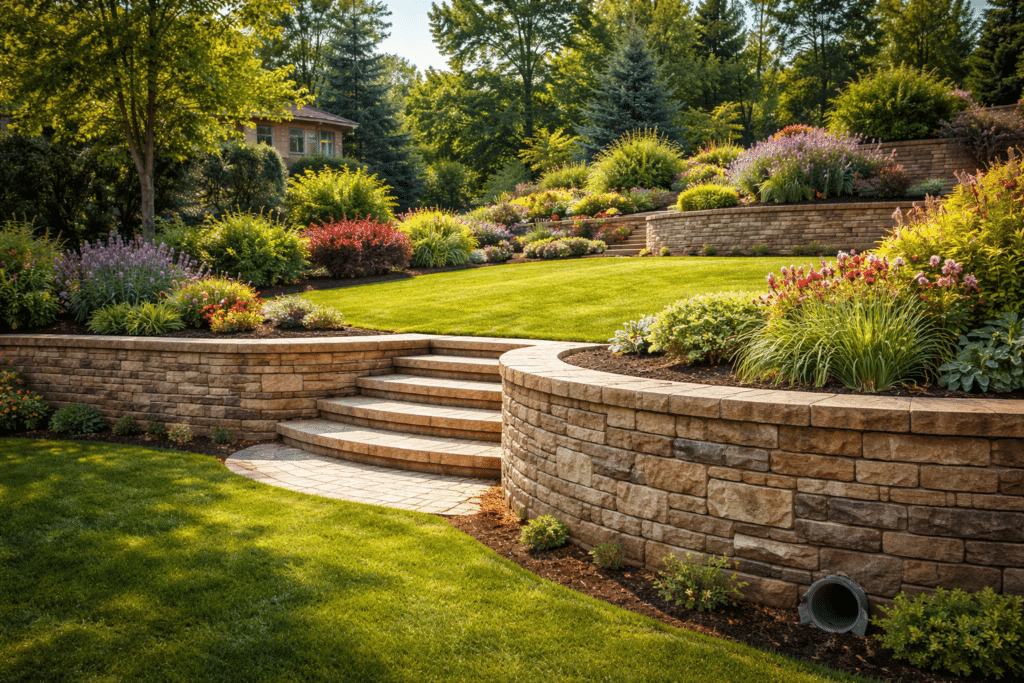
A retaining wall can solve a frustrating set of problems: sloped yards you cannot use, soil that keeps washing onto patios or sidewalks, and wet areas that never seem to dry out. In St. Charles, Illinois, those issues often show up after heavy rains, spring thaw, or when runoff keeps finding the same path down a hill.
The key is matching the solution to the cause. Sometimes you truly need a wall. Other times, grading and erosion controls do more for less disruption. And if a wall is the right move, drainage and base preparation are what separate a wall that lasts from a wall that starts leaning a few seasons later.
This guide walks through wall options, decision points, common failure patterns, and the practical details that matter most. If you want an on-site plan, Land and Lawn can evaluate your slope, soil, and water movement and recommend the simplest reliable fix for your property.
Table of Contents
Why do sloped yards and erosion cause problems in St. Charles, Illinois?
Runoff physics: Water moves faster downhill, and faster water has more ability to detach and transport soil. That is why small bare spots on a slope can turn into channels, and why mulch and topsoil can migrate after storms. [1]
Erosion chain reaction: Once soil starts moving, the slope often gets worse. You lose topsoil, plant roots get exposed, and water begins concentrating into narrower paths that cut deeper into the grade. Over time, the problem can shift from an appearance issue to a functional issue, like undermined patio edges, exposed landscape borders, or sediment washing into low areas. [1]
Local pressure points: In residential yards, erosion problems often begin at predictable spots: downspout discharge areas, the upper edge of a slope where water enters, and the toe of the slope where water slows and deposits sediment. Drainage-focused landscaping and surface protection can help, but only if water is guided to a safe route. [2]
Common slope trouble patterns you can look for:
- Bare or thinning turf lines that follow the same downhill path
- Small rills or channels forming after rain
- Mulch washing out of beds near a slope edge
- Soil collecting at the bottom of the slope, against edging, or near hardscape
- Persistent wetness halfway down a hill where water is seeping through the soil
A retaining wall is one way to interrupt that chain reaction by reducing the slope angle and creating stable, level areas. The next step is determining whether a wall is the right tool, or if regrading will solve the issue more simply.
How can you tell if you actually need a retaining wall or just grading?
Start with the goal: A retaining wall is best when you need to hold back soil and create a usable grade change. Grading is best when you can reshape the soil gently enough that it stays stable, drains correctly, and can be maintained.
A quick way to evaluate the difference is to focus on two questions: “How much elevation change are you trying to manage?” and “Do you have space to transition that change with a gentle slope?”
Signs grading may be enough:
- The slope is mild and you have room to soften it
- Your main issue is surface runoff, not soil collapse
- You want to redirect water away from a patio or foundation zone
- The yard can be reshaped without creating a steep, mow-unfriendly bank
Signs a retaining wall may be the better solution:
- You need a more vertical grade change to gain flat space
- The slope is already too steep to stabilize with planting alone
- Soil keeps sliding or washing despite reseeding and mulch
- You need to protect hardscape edges, steps, or a lower-level area
Here is a practical decision guide you can use during a walk-through:
| What you see | What it usually means | Best next step | Most likely solution |
|---|---|---|---|
| Erosion lines but plenty of yard space | Runoff needs a better path | Map where water enters and exits | Regrade plus erosion controls |
| Steep bank you cannot use or mow | Grade change is too abrupt | Measure elevation change and space | Terracing with a retaining wall |
| Soil pushing onto patio or walkway | Toe of slope is failing | Check for saturation and soft spots | Wall plus drainage and backfill |
| Water collects above the slope | Surface capture is missing | Identify runoff sources | Swale or surface capture, sometimes wall |
If you are unsure, the safest approach is to solve water movement first. Poor drainage can make both slopes and walls fail faster, so drainage planning should be part of the decision either way. [2]

When do you need retaining wall installation St. Charles homeowners trust?
Use-case trigger: A wall is typically worth it when it solves a functional problem, not just an appearance problem. In St. Charles, Illinois, retaining walls often show up in projects where homeowners want usable space, cleaner transitions around hardscape, and reliable slope erosion control.
You may be at the “call a pro” stage if any of these apply:
- You want a flat area for a patio expansion, seating area, or lawn space
- Your yard has a steep drop-off near a walkway, driveway edge, or steps
- Erosion keeps returning even after seeding, matting, or mulch
- You see soil sloughing or a soft, saturated zone forming above the slope
- A previous wall is leaning, bulging, or separating and you need a rebuild
Drainage connection: Walls and drainage problems often show up together. If runoff or saturation is contributing to a failing slope, a wall that includes proper backfill and a retaining wall drainage pipe plan can stabilize the grade and reduce recurring washouts. [3]
If you are searching “retaining wall contractor near me,” a helpful way to narrow options is to ask whether the contractor will address drainage, base compaction, and reinforcement where required. Those details matter more than block style.
What types of retaining walls work best for homes in St. Charles, Illinois?
Match the wall to the job: The best wall type depends on height, space, aesthetics, drainage demands, and whether the wall needs reinforcement. In residential work, most projects fit into a few common categories.
After you decide a wall is appropriate, the next decision is the wall system. Here is a quick comparison to keep it practical:
| Wall type | Best for | Key strengths | Typical watch-outs |
|---|---|---|---|
| Segmental retaining wall (block) | Terracing, curved runs, clean finishes | Modular, durable, repairable sections | Needs correct base, backfill, drainage |
| Natural stone | High-end look, landscape integration | Strong aesthetics, long service life | Depends heavily on craftsmanship and drainage |
| Poured concrete | Tight spaces, formal edges | Rigid structure, smooth finish options | Cracking risk if drainage and footing are wrong |
| Timber or landscape ties | Short-term, low-height landscape edges | Lower upfront complexity | Shorter lifespan, moisture exposure issues |
Practical takeaway: For many residential yards, a segmental retaining wall is the go-to because it adapts well to curves and terracing, and it can be reinforced with geogrid when needed. Manufacturer and industry guidance commonly emphasizes drainage aggregate, proper compaction, and a drain at the base to manage water behind the wall. [3] [4] [5]
The more important choice is not just material. It is whether the design fits the height, soil behavior, and water conditions of your specific site.
How does a block retaining wall contractor build a wall that lasts?
Performance basics: Most wall failures come from the same root causes: poor base prep, poor drainage, and inadequate reinforcement for the wall height and loading. Guidance for segmental systems consistently focuses on excavation depth, compacted base material, drainage fill, and careful backfill compaction. [4] [5]
A reliable construction sequence usually looks like this:
- Layout and elevation control: Establish finished grades, wall alignment, and where water will flow above and below the wall.
- Excavation to proper depth: Excavate for base material and the first course embedment so the wall resists sliding and erosion at the toe. [4]
- Leveling pad and compaction: Place and compact a crushed stone leveling pad so the first course is set accurately and stays stable. [4] [5]
- First course accuracy: Set the base blocks level, straight, and properly aligned. Most wall problems start when the first course is off.
- Drainage aggregate zone: Place free-draining rock behind the wall where specified to help water move down to the drain. [3] [4]
- Backfill in lifts: Compact backfill in thin layers to reduce settlement and movement. Some guidance recommends compacting in lifts of about 8 inches or less for better results. [6]
- Reinforcement when required: Install geogrid and tie it into the block system when the wall height, slope, or loading requires reinforcement. [6]
- Cap and finish grading: Install cap units and finish the grade so water sheds away from the wall and does not funnel behind it.
Common mistakes that shorten wall life:
- Skipping compaction steps because the wall “looks fine” during installation
- Backfilling with heavy clay right against the wall where water can collect
- Omitting drainage stone and relying on “the soil will drain”
- Placing a wall without a plan for water entering from above
If you want the wall to stay straight, the invisible parts of the build matter as much as the visible face.

Why is retaining wall for drainage design critical to prevent failure?
Hydrostatic pressure: When water builds up behind a wall, it increases lateral pressure on the wall. That pressure can push a wall outward, create bulging, and accelerate movement, especially when wet soils become heavier and lose strength. [7] [8]
Freeze and thaw factor: In climates with winter freezing, water trapped behind a wall can create additional stresses as conditions change. Even when the wall does not catastrophically fail, poor drainage can show up as shifting, joint separation, or repeated wet staining and efflorescence. [7]
Drainage is not optional: Most segmental wall guidance treats drainage as a core structural requirement, not an upgrade. Drain stone, fabric separation where needed, and a clear outlet path help keep the retained soil zone from becoming a saturated mass pushing on the wall. [3] [5] [9]
A simple way to visualize the concept is this:
Backfill zone concept:
- Surface runoff control above wall
- Free-draining aggregate behind wall face
- Perforated drain at the base to collect water
- Outlet route to daylight or approved discharge
If any one of those pieces is missing, the wall may still look good at first, but it is carrying unnecessary risk.
When should you add drain tile, gravel backfill, or weep outlets behind a wall?
Default assumption: For most residential retaining walls, plan on drainage. Free-draining gravel and a base drain are common recommendations for segmental systems because they reduce water buildup and help manage incidental groundwater. [3] [4]
Situations where drainage details become even more important:
- The slope above the wall funnels water toward the wall line
- Downspouts or hardscape runoff discharge near the retained soil zone
- The site has fine-grained soils that hold moisture
- You see seasonal wetness or seepage at the toe of the slope
- The wall supports a driveway, walkway, or other load above it
Component checklist: Here is what a contractor typically evaluates when specifying a retaining wall for drainage:
- Free-draining backfill zone behind the wall face [3] [4]
- Filter fabric where soil fines could migrate into gravel [3]
- A retaining wall drainage pipe at the base to collect and route water [3] [4]
- Weep outlets or an outlet route that will not clog and can be maintained [7] [8]
- Surface grading above the wall to keep runoff from pouring directly behind the wall [5]
Weep outlets can help relieve pressure, but they can also clog over time if not designed and maintained well. In some cases, guidance favors more maintainable drainage approaches over relying on weep holes alone. [7] [8]
What height retaining wall requires engineering or permits in St. Charles, Illinois?
Local process matters: Permit triggers can depend on wall height, total grade change, surcharge loads (like driveways), and proximity to property lines or structures. A practical first step is to confirm requirements with the local building division before construction. [12]
Common threshold: In many code-based policies, a height around 4 feet is a common point where permitting or engineered design may be required, especially when measured from the bottom of the footing to the top of the wall or when a wall supports additional loads. [13] In nearby Illinois communities, published permit guidance often uses a similar 4-foot threshold as a trigger for additional submittals. [14]
Because requirements can vary, a cautious rule of thumb is:
Permit and engineering triggers to verify:
- Walls around 4 feet and taller
- Tiered walls where total height adds up
- Walls supporting driveways, sidewalks, patios, or steep slopes above
- Walls near structures where failure would create safety risk
Even when a permit is not required, a correct drainage and base plan is still required if you want the wall to last.
What affects backyard retaining wall cost without quoting exact prices?
Cost follows complexity: If you are researching backyard retaining wall cost, the best way to estimate is to understand what drives labor, materials, and site conditions. Wall height matters, but it is not the only driver.
The main cost factors usually include:
| Cost factor | Why it matters | What it changes |
|---|---|---|
| Height and length | More material, more earth pressure to design for | Block quantity, base depth, reinforcement needs |
| Site access | Hard-to-reach yards increase labor and equipment time | Excavation approach, hauling, staging |
| Soil and moisture conditions | Wet or fine soils complicate compaction and drainage | Backfill specification, drainage details |
| Drainage requirements | Water management protects the wall long-term | Aggregate volume, pipe, outlets, grading |
| Reinforcement and engineering | Taller walls may require geogrid and design work | Materials, layout, inspections, documentation |
| Finishing work | Projects often include stairs, caps, lighting, planting | Scope beyond the wall face |
A useful planning step is to list what the wall must accomplish: create level space, stop erosion, manage water, or protect a structure. The more jobs the wall must do, the more important design details become.

How do you spot a failing retaining wall before it collapses?
Early warning signs: Most walls show symptoms before a major failure. Catching issues early can reduce how much has to be rebuilt and can prevent damage to adjacent landscaping or hardscape.
Common failing retaining wall signs include:
- Leaning or forward tilt of the wall face
- Bulging sections or a “belly” in the wall line
- Cracks, separations, or displaced blocks
- Sinking at the top edge or settlement behind the wall
- Soft, wet soil or persistent seepage near the wall base
- Erosion or washout at the toe of the wall
Drainage clue: Water problems are often visible. If you see staining, recurring wet spots, or water collecting behind the wall line, the wall may be under unnecessary pressure. Drainage improvements are one of the most common corrective steps, but they are not always enough if the base or reinforcement is already compromised. [7] [8]
A simple severity guide can help you decide what to do next:
Stability check:
- Green: minor cosmetic issues, no movement, drainage appears normal
- Yellow: small lean, minor displacement, recurring wetness, investigate soon
- Red: bulging, significant lean, rapid movement, stop and get a professional evaluation
If you see red-flag movement, avoid DIY digging near the wall until utilities are located and a plan is in place. [10] [11]
When should you call Land and Lawn for a retaining wall estimate in St. Charles, Illinois?
Right-time projects: A good on-site evaluation saves time and prevents guesswork. If you are dealing with slope erosion control, recurring saturation, or a wall that is already shifting, a contractor can identify whether the problem is water, base conditions, reinforcement, or all three.
Call for a site visit when:
- You want to convert a slope into level, usable space
- You need a wall near a patio, driveway, or steps where settlement matters
- You want a segmental retaining wall with proper drainage details
- You see movement, bulging, or separation in an existing wall
- You want a plan that addresses drainage above and behind the wall
Short CTA: If you are in St. Charles, Illinois and want a clear plan for a stable wall and clean drainage, contact Land and Lawn to schedule a site visit and estimate.
What retaining wall questions do homeowners ask most often?
Most homeowners want the same thing: a wall that looks good, stays straight, and does not create a new drainage problem. These FAQs focus on practical decision points.
Do I need a permit for a retaining wall in St. Charles, Illinois?
Permit requirements depend on height, location, and loading, and local rules can vary. Confirm with the local building division before construction, especially for taller walls or walls supporting a driveway or patio. [12] [13]
What is the difference between a garden wall and a retaining wall?
A garden wall is typically low and decorative. A retaining wall is designed to resist soil pressure and manage grade change, often requiring drainage and sometimes reinforcement. [3]
Why do retaining walls fail even when they look solid at first?
Many failures come from poor base prep, inadequate compaction, or missing drainage behind the wall. Water buildup and saturated soils can increase pressure and movement over time. [7] [8]
Do all retaining walls need a drainage pipe?
Not every wall needs the same drainage details, but many common wall systems include a base drain and free-draining aggregate as standard practice to reduce pressure behind the wall. [3] [4] [5]
How do I know if my wall needs geogrid reinforcement?
Reinforcement needs depend on wall height, slope conditions, and loads above the wall. If the wall is taller, supports a slope, or supports a driveway or similar load, reinforcement is more likely to be required. [6] [13]
Can I repair a leaning block wall without rebuilding it?
Minor movement can sometimes be corrected, but a leaning wall often points to base, drainage, or reinforcement issues. The right fix depends on the cause and the degree of movement.
What should I do before any digging for a retaining wall project?
Request utility locating before excavation and follow safe digging practices. This reduces risk and helps the project stay on track. [10] [11]
Final CTA: If you want a retaining wall plan that accounts for slope stability, drainage, and long-term performance, schedule an on-site estimate with Land and Lawn in St. Charles, Illinois.

Key Takeaways
- Retaining walls work best when you need to hold back soil and create usable grade changes, not just redirect runoff.
- Drainage behind the wall and a properly compacted base are two of the biggest drivers of long-term stability.
- A segmental retaining wall can be reinforced with geogrid when height, slope, or loads require it.
- Leaning, bulging, and persistent wetness are common failing retaining wall signs that should be evaluated early.
- Permit and engineering thresholds vary, but taller walls and walls supporting loads should be verified with local requirements.
- Contact Land and Lawn to request a retaining wall estimate in St. Charles, Illinois.
References
Slope Runoff and Erosion
[1] Understanding and Managing Water Erosion. (Accessed March 4, 2026)
[2] Landscape Drainage for Homeowners. (Accessed March 4, 2026)
Segmental Wall Construction
[3] Segmental Retaining Walls Best Practices Guide (PDF). (Accessed March 4, 2026)
[4] Segmental Retaining Wall Installation Guide (PDF). (Accessed March 4, 2026)
[5] Residential Landscape Retaining Wall Guide (PDF). (Accessed March 4, 2026)
[6] Building a Reinforced Retaining Wall. (Accessed March 4, 2026)
Drainage Design for Walls
[7] Design of Maintainable Drains for Earth Retaining Structures (PDF). (Accessed March 4, 2026)
[8] Weep Holes in Retaining Walls: What Are They? (Accessed March 4, 2026)
[9] Principles of Exterior Drainage (PDF). (Accessed March 4, 2026)
Utility Locate and Dig Safety
[10] 811 Before You Dig. (Accessed March 4, 2026)
[11] Illinois One Call System (JULIE 811). (Accessed March 4, 2026)
Permits and Height Guidance
[12] Building Permits Information. (Accessed March 4, 2026)
[13] Retaining Walls and Rock Walls (PDF). (Accessed March 4, 2026)
[14] Retaining Walls Permit Guidance (PDF). (Accessed March 4, 2026)